Why Knee Pain Happens Even Without Injury
You didn't twist it. You didn't fall. You can't even point to a moment when it started hurting. And yet, here you are, wincing every time you take the stairs or stand up after sitting too long.
It's confusing — and a little worrying — when pain shows up with no clear cause. Most of us assume knee pain means something got hurt. But knee pain without injury is far more common than people realize, and it usually points to something happening gradually inside the joint rather than a single dramatic event.
In this article, we'll walk through why this happens, what's really going on inside your knee, and what you can do about it — starting today, without needing an X-ray to get moving in the right direction.
Isn't Knee Pain Always From an Injury?
It's a fair assumption, but no — a lot of knee pain builds up slowly, with no fall, twist, or impact involved. Your knee is one of the hardest-working joints in your body. It absorbs shock every time you walk, climb stairs, squat, or stand up, and over time, that repeated stress can catch up with you.
Unlike a sprained ankle or a pulled muscle, this kind of pain often develops quietly. You might notice it first thing in the morning, after sitting for a while, or during specific movements like climbing stairs or kneeling. That gradual, movement-linked pattern is actually one of the biggest clues that something structural or muscular is at play — not a sudden injury.
Common Causes of Knee Pain Without Injury
Osteoarthritis and Cartilage Wear
Osteoarthritis is one of the leading causes of knee pain in adults, especially past the age of 40. It happens when the cartilage that cushions your knee joint gradually wears down, causing bones to rub more directly against each other.
This kind of pain often feels worse in the morning or after periods of rest, and tends to ease slightly once you start moving — though it can flare up again with prolonged activity.
Overuse and Repetitive Strain
If your daily routine involves a lot of walking, standing, squatting, or stair climbing, your knees are absorbing far more repetitive stress than you might realize. Over time, this can irritate the tendons and soft tissue around the joint, leading to a dull, persistent ache even without a specific injury moment.
Runners, people with physically demanding jobs, and even those who recently increased their activity level are especially prone to this.
Weak Supporting Muscles
Your knee doesn't work in isolation — it relies heavily on the muscles around it, especially your quadriceps and hamstrings, for stability. When these muscles are weak, your knee joint has to absorb more load and stress than it's designed to handle on its own.
This is a common but often overlooked cause of knee pain, especially in people who sit for long hours and have a relatively inactive lifestyle.
Poor Posture and Alignment Issues
Believe it or not, knee pain can start from problems well outside the knee itself. Issues with foot posture (like flat feet), hip alignment, or even the way you walk can shift how weight is distributed across your knee joint, creating uneven pressure over time.
This kind of misalignment often causes pain on just one side of the knee rather than an all-over ache.
Inflammatory Conditions
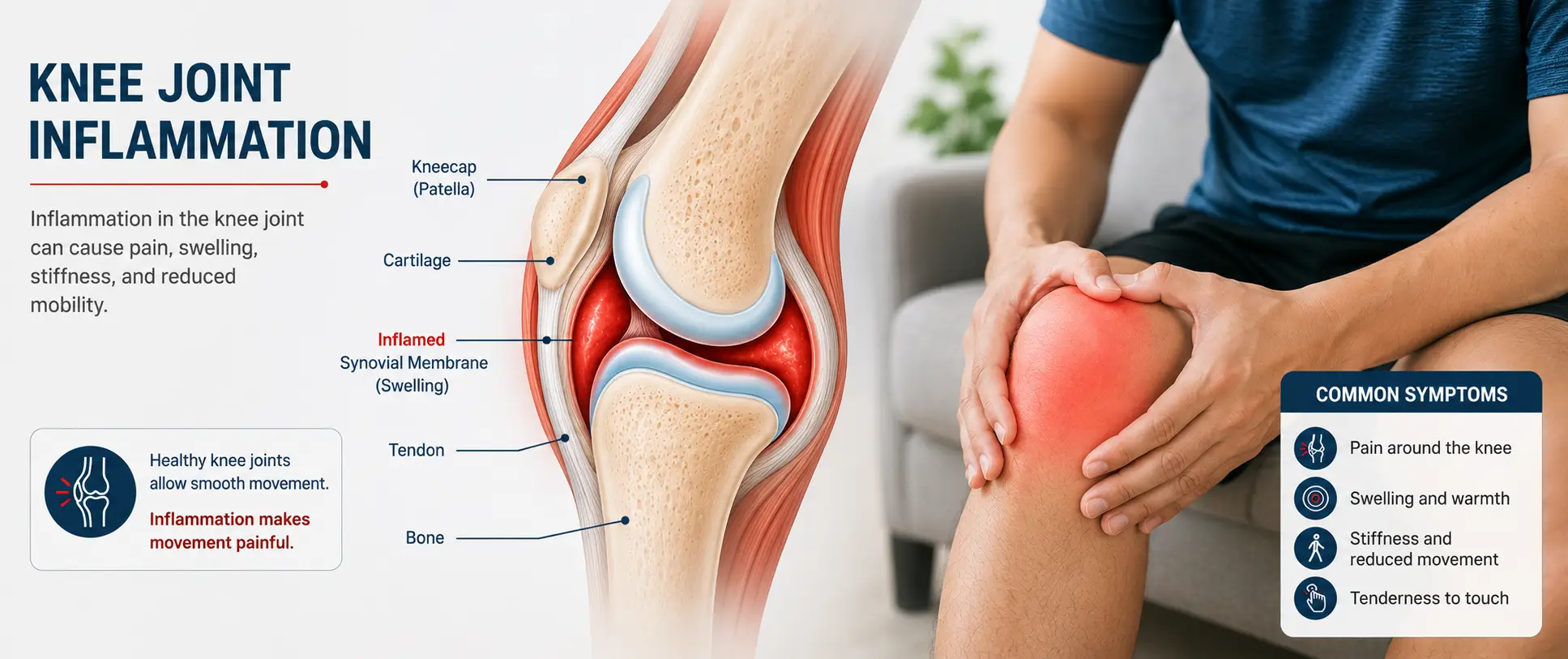
Conditions like rheumatoid arthritis or gout can cause knee pain, swelling, and stiffness without any physical injury at all. These conditions involve the immune system or crystal buildup triggering inflammation directly inside the joint.
Pain from these causes often comes with visible swelling, warmth around the joint, or symptoms in other joints as well.
Weight and Joint Load
Every extra bit of body weight adds measurable pressure to your knees, particularly when walking or climbing stairs. Over time, this added load can accelerate cartilage wear and contribute to persistent discomfort, even in the absence of any specific injury.
How to Tell What's Causing Your Knee Pain
While only a doctor can give you a definitive diagnosis, paying attention to a few patterns can help you understand what you're likely dealing with:
Morning stiffness that eases with movement often points to osteoarthritis.
Pain that worsens with activity and improves with rest suggests overuse or tendon irritation.
Pain on one side of the knee may indicate alignment or gait-related issues.
Swelling, redness, or warmth can signal inflammation and should be checked by a doctor.
Pain paired with a feeling of instability may point to weak surrounding muscles.
Common Causes at a Glance
Osteoarthritis: Pain is typically worse in the morning and may ease with light movement. Common triggers include age-related changes and cartilage wear.
Overuse or repetitive strain: Often causes a dull ache after activity. Walking, climbing stairs, or jobs that require prolonged standing can contribute.
Weak supporting muscles: May cause instability or aching during activity. Inactivity or weak quadriceps and hamstrings can be contributing factors.
Poor alignment: Often leads to pain on one side. Flat feet, hip imbalance, or gait abnormalities may contribute.
Inflammatory conditions: Can cause swelling, warmth, and stiffness. Possible triggers include autoimmune reactions or gout.
Excess joint load: Symptoms may gradually worsen over time. Higher body weight and prolonged standing can increase stress on the joint.
Practical Examples From Everyday Life
Example 1: Anil, a 52-year-old office manager, noticed his knees felt stiff every morning but loosened up after his first cup of tea and a short walk. This pattern — stiffness that improves with gentle movement — is a classic sign of early osteoarthritis.
Example 2: Sneha, a delivery executive who's on her feet most of the day, started feeling a dull ache in both knees by evening. There was no fall or twist involved — just the cumulative effect of hours of walking and standing, pointing toward overuse-related strain.
These examples show how much you can learn simply by noticing when your knee hurts, not just that it hurts.
Actionable Tips to Ease Knee Pain Naturally
Strengthen the muscles around your knee. Gentle exercises targeting your quadriceps and hamstrings can significantly reduce joint stress over time.
Avoid staying in one position too long. Prolonged sitting or standing can stiffen the joint — aim to shift position every 30–40 minutes.
Choose supportive footwear. Shoes with good arch support can reduce uneven pressure on your knees, especially if you're on your feet often.
Apply heat before activity, cold after. Heat helps loosen stiff joints; cold helps calm inflammation after activity.
Maintain a healthy weight. Even modest weight loss can meaningfully reduce the load on your knee joints.
Don't ignore mild, recurring pain. Catching gradual knee issues early makes them far easier to manage than waiting until they become severe.
When to See a Doctor
Most cases of gradual knee pain respond well to lifestyle changes and natural care, but certain signs mean it's time to get it checked professionally:
Visible swelling, redness, or warmth around the joint
Pain that wakes you up at night
A knee that feels like it's locking, catching, or giving way
Pain accompanied by fever
Symptoms that keep worsening over several weeks despite rest and care
If you notice any of these, it's best to get a proper medical evaluation rather than relying solely on home remedies.
For everyday, non-emergency knee discomfort, though, natural approaches can make a real difference. At Live Cure 24, we focus on addressing the root cause of joint pain rather than just masking it. Through a personalized Lifestyle & Diagnose Form, our therapists assess factors like your activity level, posture, and daily habits to build a tailored, drug-free pain treatment plan using acupressure — designed to support your knees without medication or invasive procedures.
FAQ
1. Why does my knee hurt if I didn't injure it? Knee pain without injury is usually caused by gradual wear on the cartilage, overuse, weak surrounding muscles, or alignment issues — not a single traumatic event.
2. Is knee pain without injury a sign of arthritis? It can be. Osteoarthritis is one of the most common causes of knee pain that develops without injury, especially in people over 40, though it's not the only possible cause.
3. Can weak muscles really cause knee pain? Yes. Your quadriceps and hamstrings play a major role in stabilizing your knee. When they're weak, your knee joint absorbs more stress than it should, which can lead to pain over time.
4. Should I keep exercising if my knee hurts? Gentle, low-impact movement is often better than complete rest, as it helps maintain joint mobility and muscle support. However, avoid high-impact activities that clearly worsen the pain.
5. Does weight affect knee pain? Yes, significantly. Extra body weight increases the load your knees carry with every step, which can accelerate cartilage wear and worsen existing discomfort.
6. When should knee pain be checked by a doctor? See a doctor if you notice swelling, warmth, night pain, a locking or giving-way sensation, or if the pain steadily worsens despite home care.
7. Can poor posture really cause knee pain? Yes. Issues like flat feet or hip misalignment can shift how weight is distributed across your knee, leading to uneven pressure and pain, often on just one side.
8. Are natural remedies effective for knee pain without injury? For many people, natural approaches like acupressure, targeted strengthening, and lifestyle adjustments can meaningfully reduce knee pain, especially when the cause is mechanical rather than a medical emergency.
Key Takeaways
Knee pain without injury is common and usually develops gradually rather than suddenly.
Common causes include osteoarthritis, overuse, weak supporting muscles, poor alignment, inflammation, and excess joint load.
Paying attention to when your knee hurts helps identify the likely cause.
Strengthening exercises, supportive footwear, and weight management can all reduce knee strain naturally.
Swelling, night pain, or a locking sensation are signs to see a doctor promptly.
Conclusion
Knee pain without injury can feel confusing, but it's rarely random. More often than not, it's your body signaling that something — whether it's cartilage wear, muscle weakness, or repetitive strain — has been building up quietly over time.
The encouraging part is that once you understand the likely cause, there's usually a clear, natural path forward. Small, consistent changes to how you move, support, and care for your knees can make a real difference, often without needing medication at all.
Not sure what's really behind your knee pain? Fill out your free Lifestyle & Diagnose Form on Live Cure 24, and get a personalized, drug-free acupressure plan built around your specific symptoms and daily habits — natural relief, guided by our therapists, from the comfort of home.

Author: Varun Ahuja
Acupressure & Acupuncture Therapist | Dietetic Aide | Pain Management Specialist with over 12 years of clinical experience, I offer non-invasive, drug-free treatments for chronic pain, health issues. My practice integrates personalized acupressure and acupuncture therapies, including advanced techniques like acupuncture, electroacupuncture, cupping, and Sujok therapy, along with diet and lifestyle counseling based on Ayurvedic principles. My mission is to make natural and accessible pain management available to all, reducing dependence on medications. Explore my work and online therapy platform at www.livecure24.com.
Feel free to use images in our website by simply providing a source link to the page they are taken from.
-- LiveCure24
Share views on Why Knee Pain Happens Even Without Injury
Please keep your views respectful and not include any anchors, promotional content or obscene words in them. Such comments will be definitely removed and your IP be blocked for future purpose.
 26th Jul 2026
 6th Sep 2025
 26th Jul 2026
 7th Aug 2026
 12th Aug 2026
 4th Jun 2025
 19th Dec 2024
 6th Sep 2025
 5th May 2025
 7th Aug 2026
 19th Dec 2024
 11th Jul 2026
 10th Oct 2025
 26th Jul 2026

