
Best Migraine Acupressure Points to Try at Home
That familiar throb behind your eye. The sensitivity to light. The urge to lie down in a dark, silent room and wait it out. If you get migraines, you know exactly how disruptive they can be — and how often the only "solution" on offer is another pill.
Here's some good news: your hands may already hold some of the relief you're looking for. Migraine acupressure points are specific spots on your body that, when pressed correctly, can help ease tension, calm your nervous system, and take the edge off a migraine without any medication.
In this guide, we'll walk through the most effective pressure points for migraine relief, exactly how to use them, and how to build a simple routine you can turn to the moment a migraine starts creeping in.
What Is a Migraine, and Why Acupressure Helps
A migraine isn't just a bad headache. It's a neurological condition that often brings throbbing pain, nausea, light sensitivity, and sometimes visual disturbances known as an aura. For many people, stress, poor sleep, dehydration, and muscle tension around the neck and shoulders are common triggers.
This is exactly where acupressure comes in. Instead of masking pain chemically, acupressure applies firm, targeted pressure to specific points connected to your nervous system. This can help relax tight muscles, improve blood flow, and calm the overactive nerve signals that often accompany a migraine.
It's a technique with deep roots in traditional Chinese medicine and Ayurvedic practice, and today it's increasingly used alongside conventional care as a natural, complementary tool for pain relief.
How Acupressure Works for Migraine Relief
Every acupressure point sits along what's traditionally described as a meridian — a pathway believed to carry the body's energy, or "bio energy." When you apply steady pressure to these points, it's thought to stimulate the nervous system, ease muscular tension, and interrupt the pain signals traveling to your brain.
Modern research on acupressure is still developing, but several small studies have found it may help reduce headache frequency and intensity for some people, particularly when used consistently and combined with good sleep and stress management habits.
The real advantage is accessibility. You don't need tools, needles, or a clinic visit — just your fingers and a few quiet minutes.
Best Migraine Acupressure Points to Try at Home
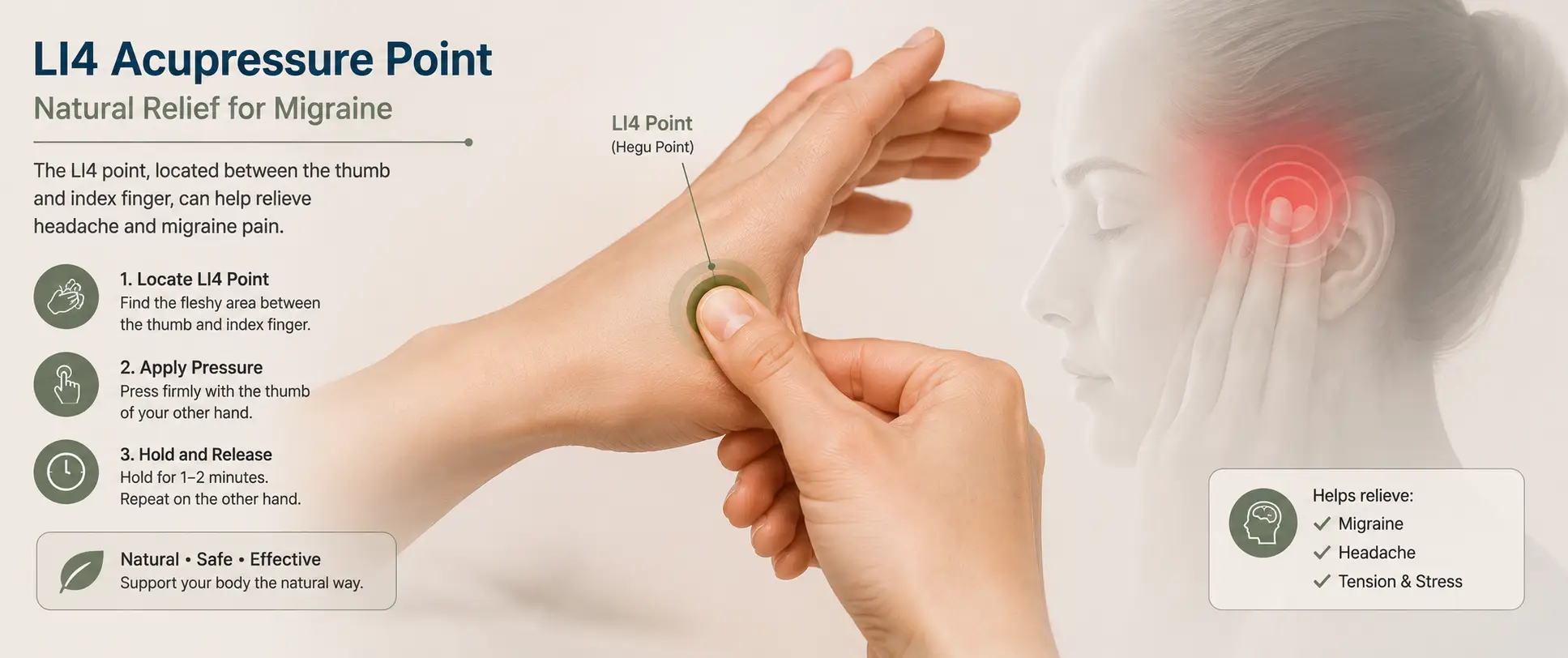
LI4 (Hegu) — The Hand Point
Located in the fleshy webbing between your thumb and index finger, LI4 is one of the most widely used points for headache and migraine relief.
How to use it: Pinch the webbing firmly between the thumb and index finger of your other hand. Press and massage in small circles for 30 to 60 seconds, then switch hands.
Note: This point is traditionally avoided during pregnancy, as it's believed to stimulate contractions.
GB20 (Feng Chi) — The Base of the Skull
This point sits in the hollow area at the base of your skull, on either side of your spine, right where your neck muscles attach to your head.
How to use it: Use your thumbs to press firmly upward into these hollows while tilting your head slightly back. Hold for 10 seconds, release, and repeat several times.
Yintang — The Third Eye Point
Found directly between your eyebrows, Yintang is often called the "third eye point" and is known for its calming effect.
How to use it: Use one finger to apply gentle, steady pressure for 1 minute while breathing slowly and deeply.
GV20 (Baihui) — The Crown Point
Located at the very top of your head, in line with the tips of your ears, this point is associated with easing mental tension and dizziness that often accompanies migraines.
How to use it: Press upward with two fingers in small circular motions for about 1 minute.
Taiyang — The Temple Point
Positioned at your temples, just beside the outer edge of your eyebrows, this is one of the most intuitive points people reach for during a headache without even realizing it's a recognized pressure point.
How to use it: Massage both temples simultaneously in slow, circular motions for 1 to 2 minutes.
PC6 (Neiguan) — The Wrist Point
Located about three finger-widths below your wrist crease, on the inner forearm, this point is traditionally used for nausea — a common migraine symptom — as well as head pain.
How to use it: Press firmly with your thumb for 1 minute, then switch to the other wrist.
Acupressure Points at a Glance
LI4 (Hegu): Located in the web between the thumb and index finger. Often used for general head and migraine pain. Apply pressure for 30–60 seconds on each hand.
GB20 (Feng Chi): Located at the base of the skull, on either side of the spine. Often used for neck tension and headaches at the base of the head. Apply pressure for about 10 seconds and repeat several times.
Yintang: Located between the eyebrows. Often used for stress-related migraines and relaxation. Apply pressure for about 1 minute.
GV20 (Baihui): Located at the top of the head. Traditionally used for dizziness and mental fog associated with migraines. Apply pressure for about 1 minute.
Taiyang: Located at the temples. Often used for temple-area pain and eye strain. Apply pressure for 1–2 minutes.
PC6 (Neiguan): Located on the inner forearm, just below the wrist. Often used for nausea or stomach upset accompanying a migraine. Apply pressure for about 1 minute on each wrist.
How to Apply Pressure Correctly
Getting the technique right makes a real difference in how effective acupressure feels. Keep these basics in mind:
Use firm, steady pressure — not so light it does nothing, not so hard it hurts.
Breathe slowly while applying pressure to help your nervous system relax.
Stay consistent. A few minutes on each point, repeated over several days, tends to work better than a single long session.
Combine points. Working through two or three points in one sitting often brings better relief than relying on just one.
Practical Example: A 10-Minute Migraine Relief Routine
Meera, a graphic designer, gets migraines almost every time she has a tight project deadline. Instead of reaching for painkillers the moment she feels the first twinge, she now follows a short routine at her desk:
She starts with 1 minute on Yintang, breathing slowly to calm her mind.
She moves to both temples (Taiyang) for 2 minutes of gentle circular massage.
She finishes with LI4 on each hand for 1 minute per side.
She says the combination doesn't just ease the pain — it gives her a moment to actually slow down, which on its own seems to reduce how intense the migraine gets.
Actionable Tips for Better Results
Start early. Applying pressure at the very first sign of a migraine tends to work better than waiting until the pain peaks.
Dim the lights and sit somewhere quiet while you do it — this alone helps calm an overstimulated nervous system.
Stay hydrated. Dehydration is a common migraine trigger, so pair acupressure with a glass of water.
Track your triggers. Keep a simple log of when migraines happen — this can reveal patterns tied to sleep, stress, or diet.
Be patient with yourself. Acupressure often works best as a regular habit, not just a one-time emergency fix.
When Acupressure Isn't Enough
Acupressure can be a genuinely useful tool for everyday migraine management, but it isn't a substitute for medical care in every situation. See a doctor promptly if you experience:
A migraine that feels like "the worst headache of your life"
Migraine accompanied by confusion, slurred speech, or weakness on one side
A sudden change in your usual migraine pattern
Migraines that are becoming more frequent or severe over time
For these situations, professional medical evaluation should always come first.
If your migraines are a recurring part of life and you're looking for a more structured, natural approach, this is exactly where a personalized plan can help. At Live Cure 24, our therapists assess your specific triggers and pain patterns through a simple Lifestyle & Diagnose Form, then build a tailored, self-administered acupressure routine designed around your body — no medication, no clinic visits required.
FAQ
1. Do migraine acupressure points really work? Many people find relief using acupressure, especially for tension-related migraines. While research is still developing, applying pressure to points like LI4 and Taiyang is widely reported to ease pain intensity and promote relaxation.
2. How long does it take for acupressure to relieve a migraine? Some people notice relief within a few minutes, while others may need to repeat the routine over 20 to 30 minutes or use it consistently over several days for the full benefit.
3. Can I use acupressure alongside my migraine medication? Yes, acupressure is generally considered a safe complementary approach. However, always talk to your doctor about combining therapies, especially if you're on prescribed medication.
4. Is acupressure safe to do every day? Yes, for most people, daily acupressure is safe and can even become part of a regular stress-relief and headache-prevention routine.
5. Are there any pressure points to avoid during pregnancy? Yes. LI4 (Hegu) is traditionally avoided during pregnancy, as it's believed to potentially stimulate uterine contractions. Pregnant individuals should consult a professional before trying acupressure.
6. What's the difference between acupressure and acupuncture? Acupressure uses finger pressure on specific points, while acupuncture uses thin needles inserted into the skin. Both are based on similar principles, but acupressure is non-invasive and can be done at home.
7. Can acupressure help with migraine-related nausea? Yes, the PC6 (Neiguan) point on the inner wrist is traditionally used to ease nausea, which often accompanies migraines.
8. How do I know which acupressure point to use for my migraine? It depends on your symptoms. Use LI4 or Taiyang for general pain, GB20 for neck-related tension, Yintang for stress-triggered migraines, and PC6 if nausea is present.
Key Takeaways
Migraine acupressure points like LI4, GB20, Yintang, GV20, Taiyang, and PC6 target different symptoms, from head pain to nausea.
Firm, steady pressure combined with slow breathing tends to work best.
Starting the routine early, at the first sign of a migraine, improves effectiveness.
Acupressure is a natural complement to medical care, not a replacement for it.
Severe or sudden changes in migraine patterns always warrant a doctor's visit.
Conclusion
Migraines can feel unpredictable, but your response to them doesn't have to be. Learning a few reliable migraine acupressure points gives you a natural, accessible tool you can turn to the moment symptoms start — no prescription required.
Like any self-care habit, consistency matters more than perfection. The more familiar you become with these points and how your body responds to them, the more effective they'll become as part of your everyday migraine management routine.
Ready to build a personalized, drug-free plan for managing your migraines? Fill out your free Lifestyle & Diagnose Form on Live Cure 24, and let our therapists guide you through an acupressure routine tailored to your specific triggers and symptoms — all from the comfort of home.

Author: Varun Ahuja
Acupressure & Acupuncture Therapist | Dietetic Aide | Pain Management Specialist with over 12 years of clinical experience, I offer non-invasive, drug-free treatments for chronic pain, health issues. My practice integrates personalized acupressure and acupuncture therapies, including advanced techniques like acupuncture, electroacupuncture, cupping, and Sujok therapy, along with diet and lifestyle counseling based on Ayurvedic principles. My mission is to make natural and accessible pain management available to all, reducing dependence on medications. Explore my work and online therapy platform at www.livecure24.com.
Feel free to use images in our website by simply providing a source link to the page they are taken from.
-- LiveCure24
Share views on Best Migraine Acupressure Points to Try at Home
Please keep your views respectful and not include any anchors, promotional content or obscene words in them. Such comments will be definitely removed and your IP be blocked for future purpose.
 9th Oct 2025
 4th Jun 2025
 7th Aug 2026
 19th Dec 2024
 6th Sep 2025
 19th Dec 2024
 26th Jul 2026
 5th May 2025
 6th Sep 2025
 8th Sep 2025
 5th May 2025
 10th Oct 2025
 11th Jul 2026
 7th Aug 2026
 12th Aug 2026

