Sciatica vs Back Pain: How to Tell the Difference
You wake up, reach down to tie your shoes, and there it is — that familiar ache in your lower back. But this time, something feels different. There's a sharp, burning sensation shooting down your leg, almost to your ankle. Is this just another back strain, or is it something more?
This is one of the most common mix-ups people run into when trying to understand their own pain. And it matters, because sciatica vs back pain isn't just a technical distinction — it changes how you should treat it, how long it might last, and when you need to take it seriously.
In this guide, we'll break down exactly how to tell sciatica and general back pain apart, what causes each one, and what you can do to find real, lasting relief without jumping straight to painkillers.
What Is Lower Back Pain?
Lower back pain is one of the most common health complaints in the world. It's estimated that up to 80% of adults will deal with it at some point in their lives.
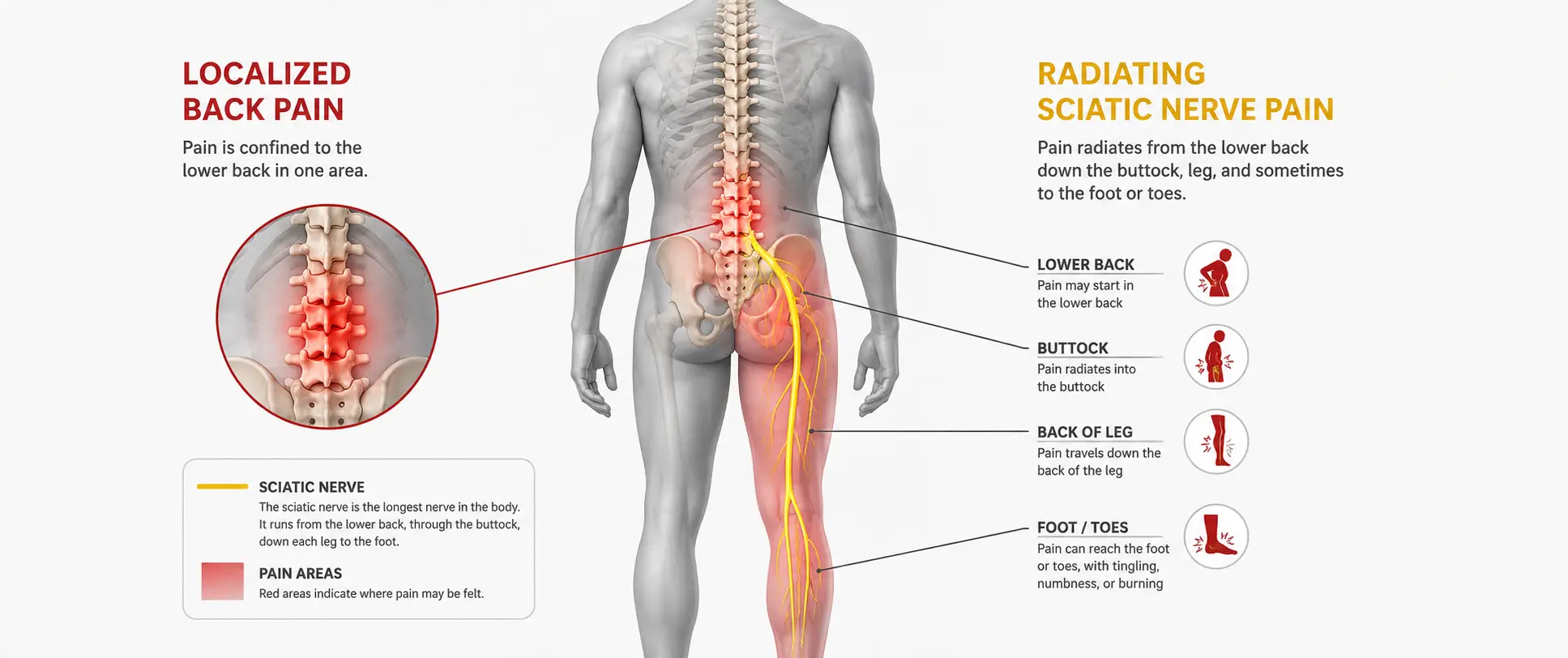
Most of the time, this kind of pain stays local. It sits across your lower back, sometimes spreading slightly to your hips, but it doesn't typically travel down your legs. It's usually caused by:
Muscle strain from lifting something heavy or twisting awkwardly
Poor posture, especially from long hours sitting at a desk
Weak core muscles that put extra load on the spine
Everyday wear and tear on the joints and discs
The good news is that ordinary back pain, while uncomfortable, is often short-lived and responds well to rest, gentle movement, and targeted natural therapies.
What Is Sciatica?
Sciatica isn't a condition on its own — it's a symptom of an underlying issue affecting the sciatic nerve, the longest nerve in your body. It runs from your lower back, through your hips and buttocks, and down each leg.
When something compresses or irritates this nerve, the pain doesn't stay put. It radiates. You might feel it start in your lower back or buttock and travel down one leg, sometimes reaching all the way to your foot.
Common causes of sciatica include:
A herniated or slipped disc pressing on the nerve root
Spinal stenosis (narrowing of the spinal canal)
Piriformis syndrome, where a muscle in the buttock irritates the nerve
Bone spurs pressing against the nerve pathway
Sciatica tends to affect just one side of the body and often comes with numbness, tingling, or a "pins and needles" feeling alongside the pain.
How Common Is Sciatica?
Research suggests roughly 40% of people will experience sciatica symptoms at some point in their lives, though only a smaller portion develop severe or long-lasting cases.
Sciatica vs Back Pain: The Core Differences
Once you understand what each condition actually is, spotting the differences becomes much easier.
Where the Pain Shows Up
General back pain usually stays centered in the lower back. Sciatica, on the other hand, travels — starting in the back or buttock and moving down one leg, often past the knee.
What the Pain Feels Like
Ordinary back pain tends to feel like a dull ache, stiffness, or muscle soreness. Sciatica often feels sharper, described as burning, shooting, or electric, and it's frequently paired with numbness or a weak sensation in the leg or foot.
What Triggers It
Back pain often flares up after physical exertion, poor posture, or sudden movement. Sciatica flares are more closely tied to positions that compress the nerve, like sitting for long periods, bending forward, or coughing and sneezing.
Comparison Table: Sciatica vs Back Pain
General Back Pain
Location: Dard sirf lower back tak seemit rehta hai.
Pain Type: Dull, aching ya stiffness jaisa dard.
Numbness/Tingling: Bahut kam hota hai.
Sides Affected: Aksar dono taraf dard hota hai.
Worsens with Sitting: Kabhi-kabhi baithne se dard badh sakta hai.
Common Cause: Muscle strain ya galat posture.
Typical Duration: Kuch din se lekar kuch hafton tak rehta hai.
Sciatica
Location: Dard lower back ya buttock se shuru hokar ek pair tak failta hai.
Pain Type: Sharp, burning ya shooting pain.
Numbness/Tingling: Aksar numbness ya tingling hoti hai.
Sides Affected: Zyadatar sirf ek taraf hota hai.
Worsens with Sitting: Baithne se aksar dard kaafi badh jata hai.
Common Cause: Nerve compression, jaise slipped disc ya spinal stenosis.
Typical Duration: Agar treatment na ho to dard lambi der tak reh sakta hai.
Common Causes Behind Each Condition
Understanding the root cause helps explain why the two conditions feel so different — and why they need different approaches.
Back pain causes are mostly mechanical: strained muscles, ligament sprains, poor sleeping posture, or a sedentary lifestyle that weakens the muscles supporting your spine.
Sciatica causes are almost always about nerve compression: something physically pressing on or irritating the sciatic nerve root, whether that's a bulging disc, a tight piriformis muscle, or age-related changes in the spine.
How to Tell Which One You Have
Simple Self-Check Signs
Ask yourself these questions:
Does the pain stay in your lower back, or does it travel down your leg?
Do you feel numbness, tingling, or weakness anywhere along the leg or foot?
Is the pain worse when you sit for long periods or when you cough or sneeze?
Is only one side of your body affected?
If you answered yes to the leg-related questions, you're likely dealing with sciatica rather than ordinary back pain.
When It's an Emergency
Most cases of back pain and sciatica aren't dangerous, but certain symptoms need immediate medical attention:
Loss of bladder or bowel control
Numbness in the groin or inner thighs (saddle anesthesia)
Sudden, severe leg weakness
Pain following a serious injury, fall, or accident
If you notice any of these, don't wait — see a doctor right away. This is not something a home remedy should address.
Practical Examples From Everyday Life
Example 1: Priya spends eight hours a day at her desk. By evening, her lower back feels stiff and sore, but the discomfort stays in that one area. This pattern points to muscular back pain linked to prolonged sitting and posture.
Example 2: Raj noticed a sharp pain in his lower back that started shooting down the back of his right leg whenever he sat in his car for more than 20 minutes. His toes even felt slightly numb. This combination of radiating pain, one-sided symptoms, and numbness is classic sciatica.
These everyday scenarios show how paying attention to where the pain travels — not just how bad it feels — gives you real clues about what's going on.
Actionable Tips for Relief at Home
Move gently, don't freeze up. Complete bed rest can actually slow recovery. Light walking or stretching often helps more than staying still.
Check your sitting posture. Use a supportive chair and take breaks every 30–40 minutes to stand and stretch.
Apply heat or cold. Cold packs work well for the first 48 hours of sharp pain; heat is better for ongoing muscle stiffness.
Sleep smart. Try sleeping on your side with a pillow between your knees to keep your spine aligned.
Avoid heavy lifting until the acute pain settles, and always bend at the knees, not the waist.
Track your symptoms. Note when the pain is worse, what triggers it, and whether it's spreading — this helps identify patterns.
Natural, Drug-Free Approaches to Pain Relief
Many people want relief without reaching for painkillers every time discomfort strikes — especially since long-term reliance on medication can bring its own set of side effects.
This is where natural, non-invasive approaches like acupressure come in. Acupressure works by applying targeted pressure to specific points connected to your nervous system, helping to ease muscle tension and calm irritated nerves without any chemicals, needles, or exercise strain.
At Live Cure 24, this approach is at the core of how we help people manage both general back pain and sciatica-related discomfort. Through a personalized Lifestyle and Diagnose Form, our therapists assess your specific pain pattern — whether it's localized muscular pain or nerve-related sciatica — and create a tailored, self-administered pain treatment plan you can follow from home.
It's worth remembering that natural therapies work best as a complement to medical care, not a replacement for it — especially if your symptoms are severe, sudden, or linked to an injury.
FAQ
1. Can sciatica go away on its own?
Mild sciatica often improves within a few weeks with rest, gentle movement, and posture correction. More persistent cases linked to disc issues may need targeted therapy or medical evaluation.
2. Is sciatica worse than regular back pain?
Not necessarily worse, but different. Sciatica involves nerve irritation, which can cause more distinct symptoms like numbness and shooting pain, while back pain is usually muscular and dull.
3. Can back pain turn into sciatica?
Yes. If an underlying issue like a herniated disc worsens and begins pressing on the sciatic nerve, ordinary back pain can develop into sciatica over time.
4. What does sciatica pain feel like compared to muscle pain?
Muscle-related back pain feels like soreness or stiffness. Sciatica feels sharper and more electric, often traveling down the leg with tingling or numbness.
5. How long does sciatica usually last?
Many cases resolve within 4 to 6 weeks with proper care, though some can persist longer if the underlying nerve compression isn't addressed.
6. Should I stretch if I have sciatica?
Gentle stretching, especially for the piriformis and hamstrings, can help relieve nerve pressure. Avoid aggressive stretching or exercises that increase pain.
7. Can sitting too much cause sciatica?
Prolonged sitting can compress the sciatic nerve and worsen symptoms, especially if posture is poor or the chair lacks proper support.
8. When should I see a doctor for back pain or sciatica?
See a doctor if pain lasts more than a few weeks, worsens over time, or comes with numbness, weakness, or loss of bladder/bowel control.
Key Takeaways
General back pain is usually localized, dull, and linked to muscle strain or posture.
Sciatica involves the sciatic nerve and causes pain that radiates down one leg, often with numbness or tingling.
Checking where the pain travels is one of the fastest ways to tell the two apart.
Most cases improve with gentle movement, posture correction, and natural pain-relief methods.
Severe symptoms like bladder/bowel changes or sudden weakness need urgent medical attention.
Conclusion
Understanding the difference between sciatica vs back pain isn't just about naming your discomfort correctly — it's about choosing the right path to relief. While ordinary back pain often settles with rest and better habits, sciatica usually calls for a more targeted approach that addresses the nerve itself.
Either way, you don't have to just push through the pain or immediately reach for medication. Paying attention to your symptoms, making small daily adjustments, and exploring natural, non-invasive therapies can go a long way toward getting your back — and your leg — back to normal.
Call-to-Action
Not sure whether you're dealing with sciatica or general back pain? Fill out your free Lifestyle & Diagnose Form on Live Cure 24, and get a personalized, drug-free acupressure treatment plan designed around your specific symptoms — no clinic visits, no medication, just natural relief guided by our therapists.

Author: Varun Ahuja
Acupressure & Acupuncture Therapist | Dietetic Aide | Pain Management Specialist with over 12 years of clinical experience, I offer non-invasive, drug-free treatments for chronic pain, health issues. My practice integrates personalized acupressure and acupuncture therapies, including advanced techniques like acupuncture, electroacupuncture, cupping, and Sujok therapy, along with diet and lifestyle counseling based on Ayurvedic principles. My mission is to make natural and accessible pain management available to all, reducing dependence on medications. Explore my work and online therapy platform at www.livecure24.com.
Feel free to use images in our website by simply providing a source link to the page they are taken from.
-- LiveCure24
Share views on Sciatica vs Back Pain: How to Tell the Difference
Please keep your views respectful and not include any anchors, promotional content or obscene words in them. Such comments will be definitely removed and your IP be blocked for future purpose.
 19th Dec 2024
 5th May 2025
 12th Aug 2026
 11th Jul 2026
 12th Aug 2026
 4th Jun 2025
 6th Sep 2025
 27th Sep 2025
 8th Sep 2025
 26th Jul 2026
 26th Jul 2026
 19th Dec 2024
 9th Dec 2024
 26th Jul 2026

